AI Customer Support Automation Platform
AI Customer Support Automation Platform Intelligent Multi-Channel Support System using n8n, LLMs & CRM Integration Overview This project…
AI Customer Support Automation Platform
Intelligent Multi-Channel Support System using n8n, LLMs & CRM Integration
Overview
This project is a fully automated AI-powered customer support system built using n8n workflows, designed to handle incoming customer queries across multiple channels (email, web forms, chat) and respond intelligently using Large Language Models (LLMs).
The system eliminates manual support overhead by automatically classifying, responding, and routing queries while seamlessly integrating with CRM systems (GoHighLevel) to maintain customer context and interaction history.
Real-World Problem Solved
- Delayed customer responses due to manual handling
- Lack of intelligent query classification
- High support team workload
- No centralized tracking of customer interactions
- Inconsistent support quality across channels
Automation Workflow Architecture
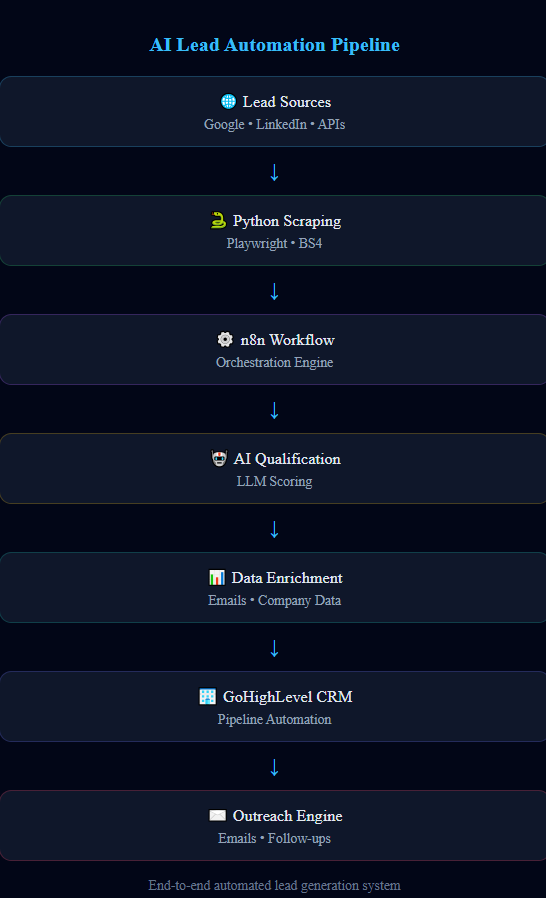
The system is built using modular n8n workflows that orchestrate multiple services:
- Trigger Layer: Webhooks, Gmail API, or chat integrations capture incoming queries
- Processing Layer: AI classification and intent detection using OpenAI
- Enrichment Layer: Python services fetch additional context (user history, FAQs)
- Decision Layer: Conditional routing based on query type
- Action Layer: Automated replies, escalation, or CRM updates
AI Processing & Query Handling
- Intent Classification using LLM prompts (billing, technical, general inquiries)
- Entity Extraction (order IDs, names, product references)
- Context-Aware Responses generated dynamically
- Confidence Scoring to decide automation vs escalation
If confidence is high → automated response is sent. If low → query is escalated to a human agent with full context.
Python-Based Data Enrichment
Custom Python microservices were developed to enhance AI decision-making:
- Fetch customer history from database
- Retrieve relevant FAQ answers
- Normalize and clean incoming text
- Perform similarity search for known issues
CRM Integration (GoHighLevel)
- Automatically create/update contacts
- Log all interactions as activities
- Trigger follow-up workflows
- Segment users based on query type
This ensures complete visibility of customer interactions and enables long-term relationship management.
Automation Capabilities
- Instant AI-powered email replies
- Automatic ticket categorization
- Escalation to Slack or internal teams
- Follow-up email automation
- Multi-channel support orchestration
System Flow (Example)
- User sends support email
- n8n webhook triggers workflow
- LLM classifies intent
- Python service enriches data
- AI generates contextual response
- Email reply is sent automatically
- Interaction logged in GoHighLevel CRM
Impact & Results
- Reduced support response time to near real-time
- Automated handling of repetitive queries
- Improved customer satisfaction
- Scalable support system without increasing team size
This project showcases deep expertise in workflow automation, AI integration, backend services, and CRM orchestration — delivering a production-ready intelligent support system.